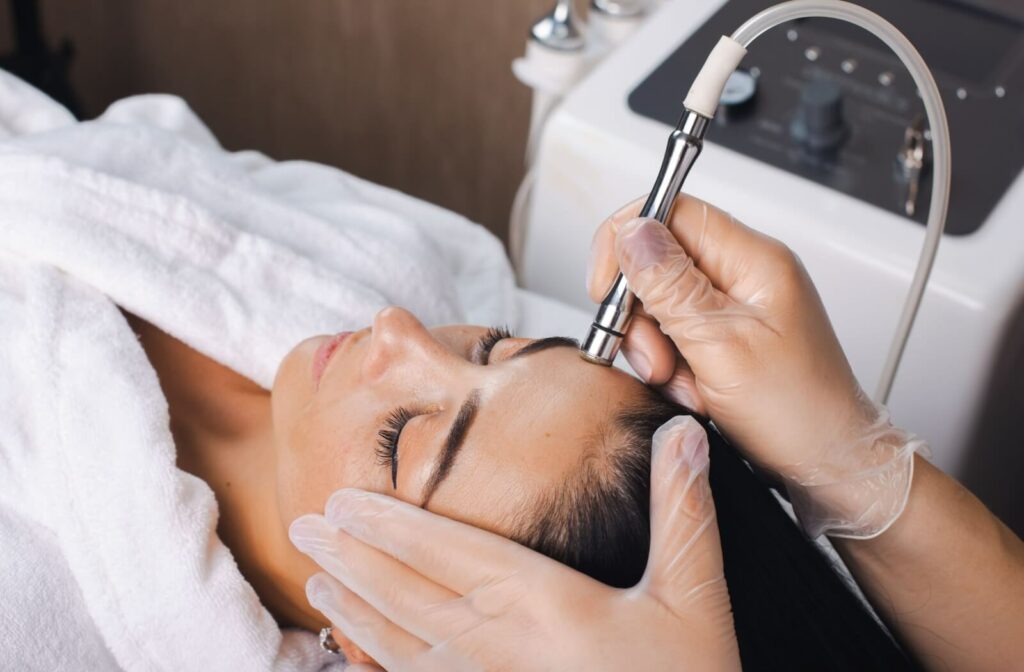
‘Microabrasion’ is definitely a mouthful. But it’s really not as complex as it sounds. Microdermabrasion is a noninvasive treatment that gently removes the outermost layer of dead skin cells from your face.
When done correctly, this is a great way to support your skin, encouraging healing and regeneration during periods of acne-flare ups. However, acne type and severity matter.
If you have active, inflamed pimples in the area where you’re considering treatment, it’s better to wait until they heal. Microdermabrasion over active breakouts can spread bacteria and potentially cause scarring.
More on Microdermabrasion
Microdermabrasion essentially buffs away dead skin cells. It mechanically exfoliates your skin to reveal a smoother surface underneath, while stimulating your skin’s natural renewal process.
It sounds more intense than it is—the process is relatively gentle and seamless. Many patients see visible results after just one session. Besides, there’s virtually no downtime, so you can return to your daily routine immediately after treatment.
However, there’s one thing that we have to clarify right away: shaving your face with a facial razor is not the same as microdermabrasion. Facial shaving, (or dermaplaning), when done professionally, removes surface peach fuzz (vellus hair) and some dead skin cells, but it primarily focuses on hair removal.
On the other hand, microdermabrasion uses a device with a fine, abrasive tip to deeply exfoliate the skin and remove the top layer of dead skin cells. It also promotes cell turnover and can help improve issues like uneven texture, hyperpigmentation, and fine lines.
While shaving can temporarily make your skin feel smoother, microdermabrasion provides a deeper exfoliation and more targeted skin benefits, making it a more comprehensive treatment for skin renewal.
How Microdermabrasion Helps with Acne
Along with evening out your skin for a smoother look and feel, microdermabrasion done right can help address active breakouts. Here’s how:
Actively Unclogs Pores
One of the primary reasons why blemishes appear is because of pores that are clogged with dead skin cells, oil, and bacteria.
Microdermabrasion physically removes dead skin cells that can block your pores, making it easier for your skin to breathe and reducing the likelihood of new breakouts forming.
Reduces Acne Scarring
If you’ve dealt with acne for a while, you may have some scarring or uneven skin texture. Not all scars are the same; some are deeper than others.
Microdermabrasion can’t remove these marks, but it does help improve the appearance of mild scars. How? Because this physical process itself encourages skin cell turnover and promotes the growth of new, healthy skin cells.
Improves Product Absorption
Skincare products are a fantastic (and soothing) way to support and achieve healthier, more radiant skin. The trick is making sure these products are working to the best of their ability, which is where microdermabrasion comes in.
After a session, your skin is better able to absorb topical acne treatments like benzoyl peroxide or salicylic acid. This means your existing acne medications can work more effectively.
Stimulates Collagen Production
The gentle abrasion stimulates your skin’s healing response, which includes increased collagen production. This can help improve skin texture and reduce the appearance of fine lines that sometimes accompany acne-prone skin.